Sheet 07 · Florida Keys
Key Largo Guide: Diving Capital of the Florida Keys
Key Largo as a place to stay, not a place to drive through: the reef and wreck dives, what a boat trip costs, where to sleep at every price, and the honest case for skipping the island if you will not get wet.
At 7:15 on a January morning the parking lot of a dive shop at mile marker 100 is fuller than the parking lot of any restaurant on the island will be all day. People are pulling wetsuits out of pickup beds, arguing amiably about whether the wind will lay down by ten, and drinking gas-station coffee. That is the honest introduction to Key Largo Florida: a 33-mile island whose entire commercial logic is built around getting people into the water before the sea breeze picks up, and which does not particularly care what you do after four in the afternoon.
This guide covers Key Largo as a place to stay for two or three nights rather than as the first hour of a drive to Key West — the diving and snorkeling that justify the trip, where to sleep at every price point, what to eat, and the honest case for skipping it if you have no intention of getting wet. Prices and hours were checked in September 2026; treat them as the right order of magnitude, since Keys rates move sharply between the February peak and the September trough.
At a glance: what a day in Key Largo costs
| Item | Typical 2026 price | Notes |
|---|---|---|
| John Pennekamp park entry | $8 per vehicle (2–8 people) + $0.50 per person | $4.50 solo driver or motorcycle, $2.50 walk-in or cycle |
| Two-and-a-half-hour reef snorkel trip | $40–$60 adult | Gear rental usually $15–$25 extra |
| Glass-bottom boat, 2.5 hours | $40–$55 adult | Runs from Pennekamp; check sea state before booking |
| Two-tank reef dive | $95–$140 | Plus gear; nitrox usually $15 a tank |
| Two-tank wreck dive (Spiegel Grove) | $130–$180 | Advanced certification effectively required |
| Kayak rental | $25–$40 for two hours | Pennekamp mangrove trail is the best paddle |
| Dive-shop motel room, winter | $180–$260 | Cheaper midweek, cheaper still June–October |
| Bayside resort room, winter | $300–$450 | Sunset side; imported sand, not natural beach |
| Fish dinner, mid-range | $28–$38 per plate | Ask what came in that morning |
Where Key Largo actually is, and how long it takes to get there
Key Largo begins at MM 106, where US 1 crosses Jewfish Creek from the mainland, and runs southwest to about MM 90 where Tavernier takes over. It is the longest island in the chain and the closest to Miami — roughly an hour from Miami International in light traffic, and closer to two hours on a Friday afternoon when everyone in Dade County has the same idea.
There is a second way in that almost nobody uses: Card Sound Road, which leaves the mainland at Florida City, crosses the toll bridge at Alabama Jack’s, and rejoins US 1 at MM 106.5. It is a few miles longer, it costs a couple of dollars, and on a busy weekend it saves you the queue on Jewfish Creek Bridge. It also passes a bar built on a barge where a bluegrass band plays on Sunday afternoons and the conch fritters are the reason people take the road at all.
Key Largo to Key West is 106 miles and three and a half to four hours on US 1. That matters for planning: Key Largo is a poor base for a Key West-focused trip, and Key West is a poor base for a diving trip. Our island-by-island guide to the Florida Keys sets out the splits that work.
Diving in Key Largo: why it is the best in the continental United States
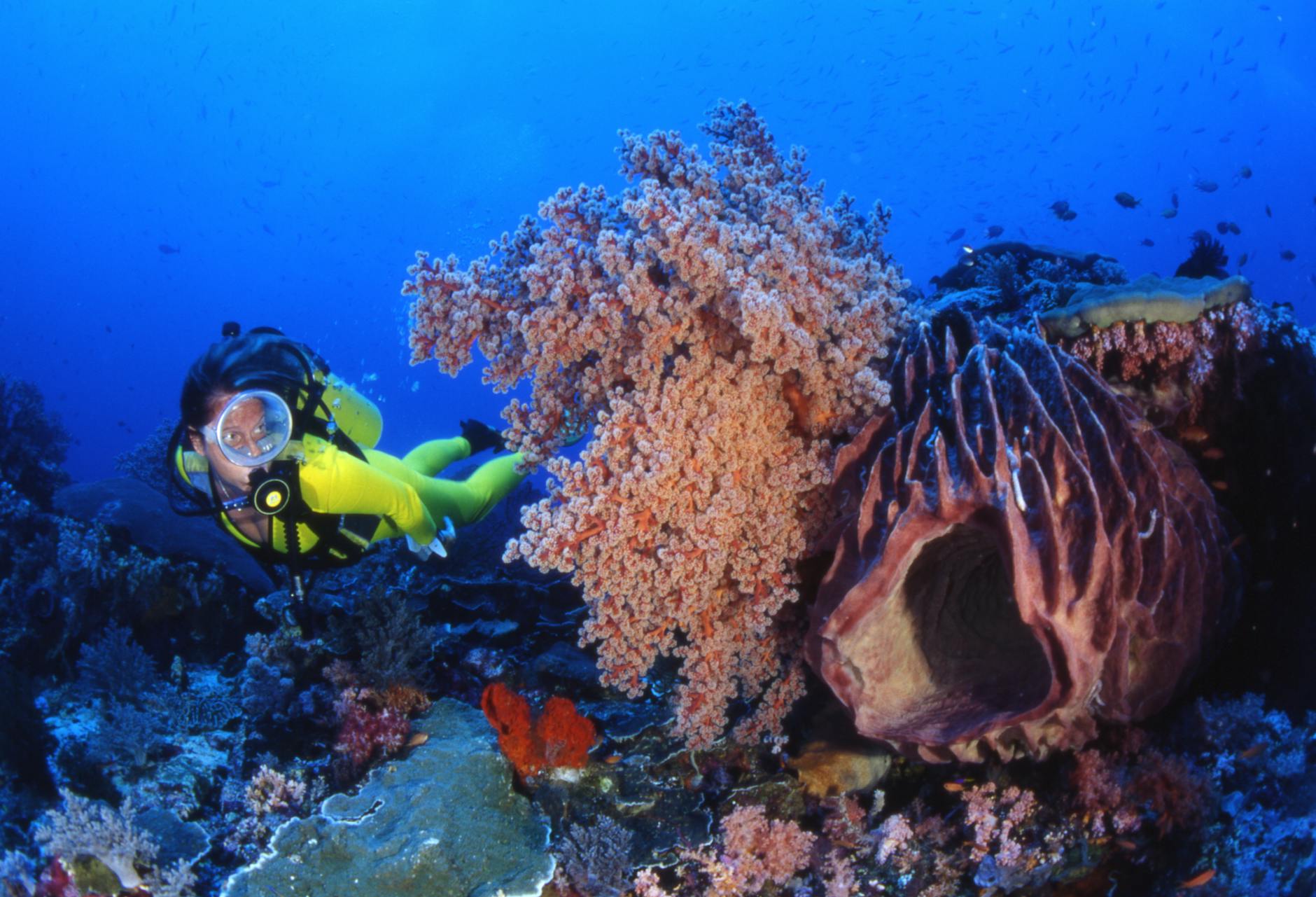
Three things line up here and nowhere else in the country. The Florida Reef — the only living coral barrier reef in the continental US and the third-largest barrier reef system in the world — sits four to six miles offshore, which is a twenty-five-minute boat ride rather than an hour. The reef here is protected inside John Pennekamp Coral Reef State Park and the Florida Keys National Marine Sanctuary, so it has had decades of no-take, no-anchor management. And there is a cluster of large, deliberately sunk ships within the same short run.
The reef dives
- Molasses Reef — the most-dived site in Key Largo and deservedly so. Spur-and-groove coral formations in 15 to 50 feet, big schools of grunt and snapper, resident barracuda, green turtles most days. Mooring buoys numbered so operators can spread out. Suitable for snorkelers on the shallow end and divers on the deep.
- Key Largo Dry Rocks — the shallow site with the Christ of the Abyss, a nine-foot bronze standing in about 25 feet of water, arms raised. It is a copy of a statue in the Mediterranean off Portofino, donated in 1965. Snorkelers can free-dive to it comfortably on a calm day. On a churned-up day you will see a green shape and be underwhelmed, so pick your morning.
- French Reef — swim-throughs, small caves and ledges in 20 to 45 feet. More structure than Molasses and usually less crowded.
- The Elbow — furthest out, most exposed, and where the older wrecks are. Nineteenth-century wreckage scattered across the bottom among the coral.
The wreck dives
The Spiegel Grove is the headline: a 510-foot Landing Ship Dock, sunk deliberately in 2002 six miles off Key Largo, sitting in about 130 feet of water with the highest superstructure reaching up to roughly 60 feet. Hurricane Dennis rolled her upright in 2005, which improved the diving considerably. She is enormous — you cannot see one end from the other — and the honest position is that Open Water divers should be here only with a guide and only for the shallow superstructure. Advanced Open Water plus a recent deep dive is what most operators want before they will let you dive it as a buddy pair. Current on the wreck can run hard, and the descent line is not optional.
The USCGC Duane is a 327-foot Coast Guard cutter sitting upright in 120 feet, decks at about 100, and it is the prettier dive of the two — coral-encrusted, swarming with barracuda and jacks, with a crow’s nest reachable at about 65 feet. Her sister ship Bibb lies on her side nearby in similar depth and is a more serious proposition. The Benwood, a freighter torpedoed in 1942, sits shallow at 25 to 45 feet and is the wreck to dive if your certification is basic and your interest is real — it is broken up, covered in fire coral, and full of fish.
Choosing an operator
There are twenty-plus dive operators between MM 90 and MM 106 and the difference between them is not the boat. It is the ratio, the briefing and whether they will tell you no. Ask three questions when you call: how many divers on the boat, whether a guide is in the water with you, and what they do if the site you booked is blown out. An operator that answers “we’ll go somewhere sheltered and still get you two tanks” is being straight with you. One that promises the Spiegel Grove in a 20-knot easterly is not.
For context on how the diving compares at the far end of the chain — deeper wrecks, longer boat rides, the Vandenberg — see our Key West scuba diving guide.
Snorkeling without a scuba card
Key Largo is genuinely good for snorkelers, which is unusual — most world-class dive destinations treat snorkelers as an afterthought. The reason is the same reef: much of Molasses and all of Key Largo Dry Rocks sit in 10 to 25 feet of water, shallow enough that you see everything from the surface.
The Pennekamp concession runs a two-and-a-half-hour snorkel trip two or three times a day for around $40–$60 including the park’s own boat and crew, and it is the best-value water activity in the Upper Keys. Private operators run smaller boats for more money and fewer people. Both are entirely at the mercy of wind: mornings are almost always calmer than afternoons, and a sustained easterly over 15 knots means milky water regardless of who you booked with.
Shore snorkeling in Key Largo is poor, and it is worth saying so plainly. Cannon Beach inside Pennekamp has a small scatter of ballast stones and cannon replicas from a 1715 Spanish wreck about 100 feet out in shallow water; it is fun for children and it is not a reef. If somebody tells you that you can snorkel the reef from the beach in Key Largo, they are wrong — it is six miles offshore. Our Key West snorkeling guide covers the shore options at the southern end, which are better but still limited.
John Pennekamp Coral Reef State Park
The park is at MM 102.6, opens at 8:00 a.m. and closes at sundown every day of the year, and costs $8 per vehicle carrying two to eight people plus a 50-cent per-person Monroe County surcharge. On land it is modest: a visitor center with a 30,000-gallon reef aquarium, two short trails through hardwood hammock and mangrove, two small swimming beaches with imported sand, and a boat ramp. The value is entirely in what leaves from its dock.
- Glass-bottom boat — a large catamaran to Molasses Reef, about two and a half hours, $40–$55. Good for people who will not or cannot get in the water. Genuinely miserable in a chop; ask about the forecast and take the pills before you board, not after.
- Snorkel trip — the best thing the park sells.
- Scuba trip — two-tank, reef sites, guided.
- Kayak and paddleboard rental — the mangrove trail behind the visitor center is sheltered from almost any wind and full of juvenile fish, rays and wading birds. $25–$40 for two hours and one of the quietest hours you will have in the Upper Keys.
- Canoe trail — a marked route through the mangroves that takes about an hour and a half at a gentle pace.
The park fills. On a February weekend or any public holiday, the gate closes when the lots are full, sometimes before 10:00 a.m. If you have booked a boat trip, arrive 45 minutes before your departure, not fifteen.
Where to stay in Key Largo
Dive motels (MM 99–104): $180–$260 in winter
Plain, clean, two-story motels with a dive shop attached and a boat tied up out back. Some have a pool, most have a fish-cleaning station, none have a spa. If the point of the trip is to be underwater by 8:30 a.m., this is the right choice and the extra $150 a night for a resort buys you nothing you will use. Book directly and ask about dive-and-stay packages, which frequently beat the sum of the parts.
Bayside resorts: $300–$450 in winter
The west-facing properties on Florida Bay — sunset views, tiki bars, small imported-sand beaches, kayaks included, and a genuinely lovely place to sit at 6:30 p.m. The beaches are not natural and the swimming is shallow and silty; you are buying the sunset and the atmosphere, and on a good evening that is a fair trade.
Oceanside resorts: $350–$600
Fewer of these, and the water access is over rock and seagrass rather than sand. The advantage is being on the reef side, which means a shorter run to the dive sites if the property has its own dock.
Jules’ Undersea Lodge: around $1,000 per person
A converted 1970s research habitat sitting 21 feet down in a lagoon at MM 103.2, entered by scuba. Two bedrooms, a common room, hot showers, and a pizza delivered by a diver in a watertight case. You need to be a certified diver or complete their short course. It is a story rather than a hotel, the windows look out on a murky lagoon rather than a reef, and people who go in understanding that come out delighted.
Camping
Pennekamp has 47 sites, small and shaded, booked eleven months in advance. There is no camping elsewhere on the island worth recommending. The better Keys campgrounds are further south; see our Key West camping guide for how the state park reservation window actually works.
Eating in Key Largo
The good news is that Key Largo has real fish, landed locally, and a handful of restaurants that treat it properly. The bad news is that it also has a long strip of highway restaurants aimed squarely at people who will be here for one night and never come back, and the price of a mediocre grouper sandwich in that category is $24.
- The Fish House (MM 102.4) — the reference point. Whatever came in that morning, prepared “Matecumbe” style with tomato, basil, capers and olive oil, or smoked, or fried. $28–$38 for a plate. The adjacent Encore annex takes reservations when the main room does not.
- Mrs. Mac’s Kitchen (MM 99.4) — license plates on the walls, conch chowder, chili, and Key lime pie that is properly yellow and properly tart. There is a second location a mile down the road when the first is full. Breakfast is good and cheap.
- Alabama Jack’s (Card Sound Road) — technically not on Key Largo at all, on a barge in a mangrove creek. Conch fritters, a bluegrass band on weekend afternoons, closes at 7:00 p.m. because the mosquitoes take over. Worth the detour.
- Snapper’s, Sundowners, and the bayside sunset bars — you are paying for the dock and the light. Food is fine, prices are $6–$8 higher than they should be, and nobody minds because the sun is going down over Florida Bay.
- The Caribbean Club (MM 104) — a genuine 1938 dive bar with a claim on the 1948 Bogart film Key Largo (a few second-unit shots; the picture was made in Hollywood). Cheap beer, pool table, fantastic sunset, no food to speak of.

What else there is to do
- Dagny Johnson Key Largo Hammock Botanical State Park — 2,400 acres of West Indian tropical hardwood hammock, one of the largest surviving tracts anywhere, on a paved former subdivision road that makes it wheelchair-accessible. Free-ish, quiet, and the best land-based hour on the island. Bring repellent.
- Florida Keys Wild Bird Center (MM 93.6, technically Tavernier) — rehabilitation aviaries and mangrove boardwalks, entry by donation.
- Sunset at Sunset Point or from a bayside bar — the west-facing bay is the one thing Key Largo does better than Key West, because you can watch it from a dock without 300 other people applauding.
- African Queen — the actual steam launch from the 1951 Bogart and Hepburn film is docked at MM 100 and runs short canal cruises. A small, strange, entirely charming thing.
- Fishing — backcountry flats into Florida Bay and Everglades National Park, or offshore for sailfish and mahi. Key Largo’s fishing is good but Islamorada’s is better and the docks are 20 minutes south. Our Key West fishing guide explains how the flats, reef and offshore fisheries differ.
The bay side: Florida Bay and the edge of the Everglades
Almost everybody who comes to Key Largo faces the ocean, and the water behind the island is the more interesting half. Blackwater Sound, Buttonwood Sound and Barnes Sound open west into Florida Bay, and the western third of that bay is inside Everglades National Park. It is a foot to four feet deep for miles, floored with turtle grass, and it holds bonefish, permit, redfish, snook, tarpon and more wading birds than you will be able to name.
You can see it three ways. A backcountry skiff charter out of a Key Largo marina runs $500–$700 for a half day for two anglers and is the serious option. An eco or sightseeing boat tour costs $60–$90 for a couple of hours and will get you into the mangrove creeks and probably onto a bird rookery. Or you can rent a kayak and paddle the sheltered creeks yourself for $25–$40, which on a windless morning is the best value in the Upper Keys.
A word of warning if you rent a powerboat: the bay is shallower than it looks, the flats are unmarked, and running aground on seagrass is both expensive and illegal — Florida prosecutes seagrass damage, and the scars take a decade to heal. Stay in the marked channels unless you know how to read water color, and when the bottom goes from blue-green to brown, slow down.
A workable two-night Key Largo itinerary
- Day one, morning — arrive, drop bags, take the Pennekamp snorkel trip or a two-tank reef dive. Mornings are calmer; book the first departure.
- Day one, afternoon — Dagny Johnson hammock trail while the wind is up, then a bayside dock at sunset.
- Day one, evening — the Fish House, booked ahead, or Mrs. Mac’s if you did not.
- Day two, morning — the wreck, if you are certified and the sea state allows; the mangrove kayak trail if it does not.
- Day two, afternoon — the African Queen canal cruise, or the drive out to Alabama Jack’s for conch fritters and whatever band is playing.
- Day three — leave early and be at Bahia Honda by mid-morning on the way south.
When to go
Water clarity is the whole game here, and clarity is a function of wind. Late spring — May and early June — has the lightest average winds of the year and the best visibility, along with warm water and prices below the winter peak. That is the answer for divers.
December through April brings the pleasant air temperatures and the crowds, plus periodic cold fronts that push through with two or three days of hard north wind and blown-out dive sites. If you book a three-day trip in February, expect one of those days to be a write-off.
July and August are hot, still, and often superb underwater, with 85°F water and long flat mornings. They are also the peak of sargassum season, when Atlantic-facing shorelines collect windrows of brown weed; the 2026 bloom was forecast well above historical averages. It does not affect the reef, only the beaches, and Key Largo has almost no beaches to affect. September and October are hurricane season’s peak, the cheapest weeks of the year, and a genuine gamble.
Is Key Largo worth staying on? The honest verdict
If you dive or snorkel, yes, unequivocally, for two nights minimum — because a single day gives you one weather window and if that window is a 20-knot easterly your trip underwater does not happen. Two nights gives you two mornings. That is the whole argument.
If you do not intend to get in the water, Key Largo is a 20-mile strip of highway with shopping plazas, marine supply stores, no natural swimming beach, no walkable center, and nothing happening after nine in the evening. It is not charming. Islamorada has better food, Marathon has better beaches and family attractions, Bahia Honda has the sand, and Key West has the town. Stop for lunch at the Fish House, look at the reef aquarium in the Pennekamp visitor center, and keep driving.
Frequently asked questions
How far is Key Largo from Miami?
About 60 miles to MM 100, or an hour to ninety minutes depending on traffic through Homestead and on Jewfish Creek Bridge. Card Sound Road is the alternative when US 1 backs up.
Can you snorkel the reef from the beach in Key Largo?
No. The reef is four to six miles offshore and reachable only by boat. The shallow ballast-stone site off Cannon Beach inside Pennekamp is the only in-water attraction you can swim to, and it is not a reef.
Do I need to be a certified diver to see the Spiegel Grove?
Effectively yes, and Advanced Open Water in practice. The wreck’s shallowest structure is around 60 feet and the sand is at 130. Operators generally want proof of certification and a recent deep dive before they will put you on it as a buddy pair; Open Water divers may be taken with a guide on the shallow portions.
How much is entry to John Pennekamp?
$8 per vehicle for two to eight people, plus a 50-cent per-person Monroe County surcharge, $4.50 for a single-occupant vehicle or motorcycle, and $2.50 per pedestrian or cyclist. Open 8:00 a.m. to sundown, 365 days a year.
Is Key Largo good for families?
Moderately. The glass-bottom boat, the kayak trail and the aquarium in the visitor center work well for children over six. There is no proper swimming beach, no boardwalk, and little to do in the evening. Marathon is the better family base in the Keys — see our Key West with kids guide for the equivalent at the southern end.
Was the film Key Largo shot in Key Largo?
Barely. The 1948 Bogart and Bacall picture was shot almost entirely on Warner Brothers sound stages, with a small amount of second-unit footage in the Keys. The Caribbean Club at MM 104 has the strongest local claim and leans into it. The African Queen, from a different film entirely, is genuinely here.
How many days do you need in Key Largo?
Two nights if you dive, so that a single bad-weather day does not cost you the trip. One night if you snorkel. None if you do neither.
And if the reef here leaves you wanting deeper water and a different flag, the crossing starts at the far end of the chain rather than this one. Our Key West to Bahamas guide sets out the ferry, the flights and the paperwork, with an honest account of how much of a day each option consumes.
Related Key West Guides
- The Florida Keys beyond Key West — the whole chain, island by island
- Key West scuba diving — how the wrecks and reefs compare at the southern end
- Key West snorkeling — reef trips and the few genuine shore spots
- Miami to Key West — every route down the chain, compared
- Key West fishing — flats, reef and offshore
- Key West camping — the state park reservation game
- Key West with kids — the family angle at MM 0
Photo Credits
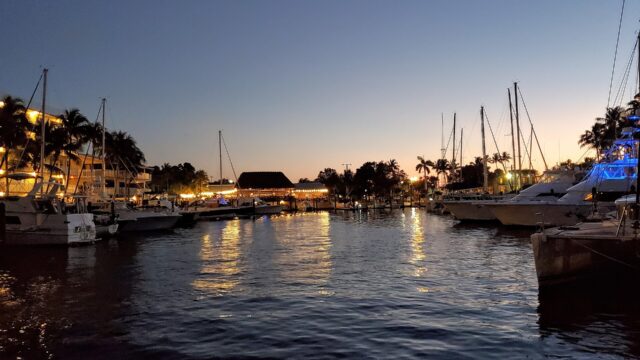
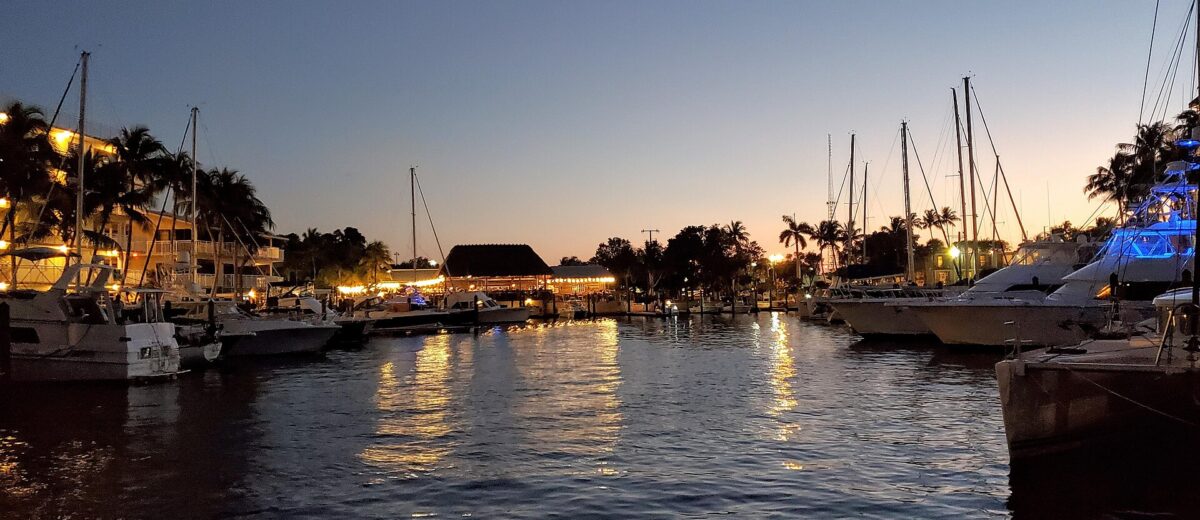
Key Largo marina at dusk: A Key Largo marina at dusk by Baron Maddock, CC BY 4.0, via Wikimedia Commons.
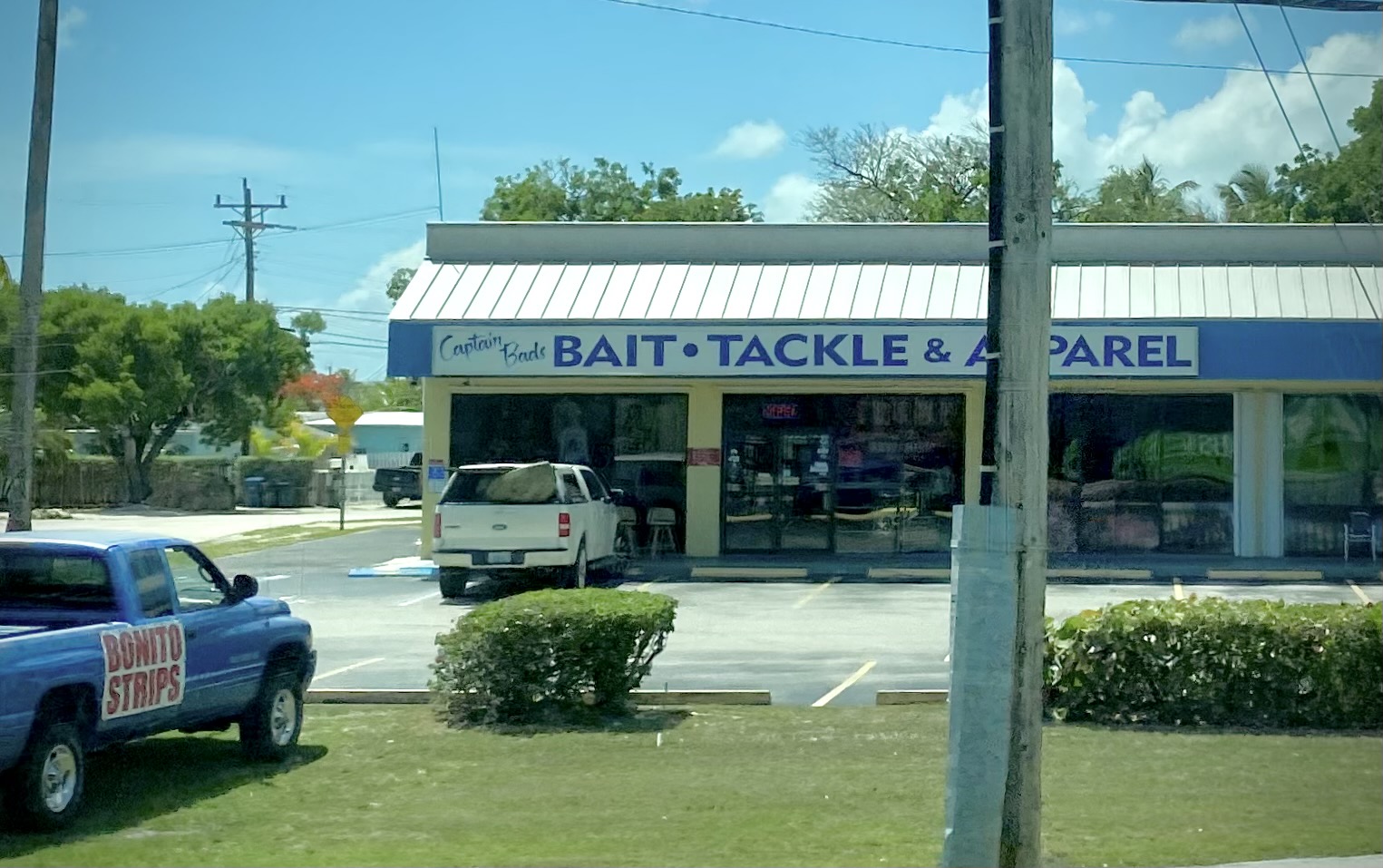
Bait and tackle shop on the Overseas Highway: Bait, tackle AND apparel – Overseas Highway, Key Largo, Florida by Sharon Hahn Darlin, CC BY 2.0, via Wikimedia Commons.
Sources & corrections
Rates, hours and closures verified against operator listings and on-island visits. Prices are peak-season unless noted.