Sheet 07 · Florida Keys
Robbies of Islamorada: Tarpon Feeding and Marina Guide
Feeding wild hundred-pound tarpon off a dock at MM 77.5 for $7.50: prices, hours, the pelican problem, the best time to go, and what else at Robbie's Marina is worth your time.
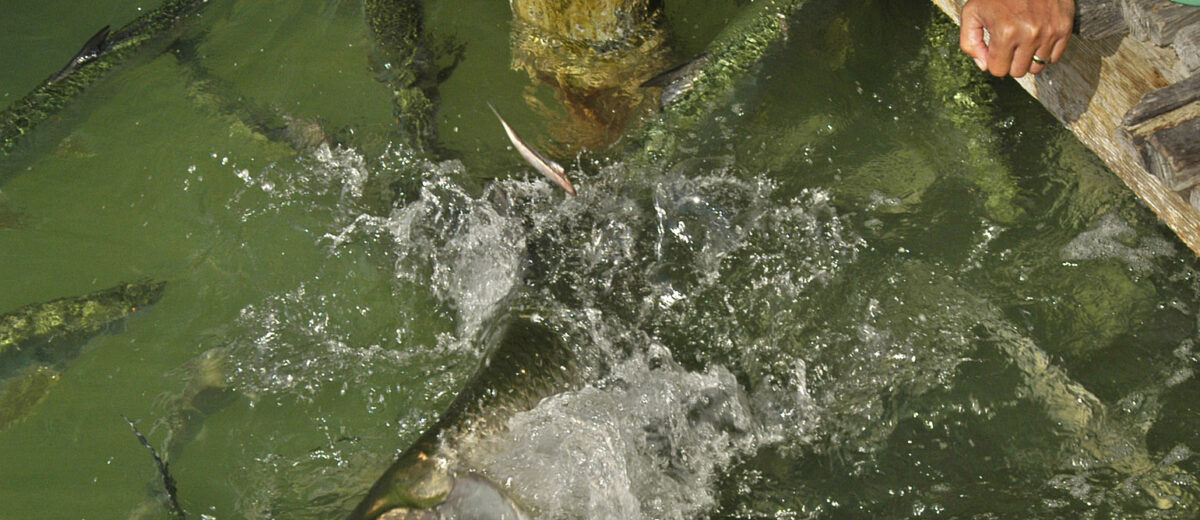
The first thing you notice at the end of the dock is not the tarpon. It is the pelicans, a dozen of them standing on the pilings with the patient, faintly criminal look of birds who know exactly what is in your bucket. Then someone next to you dangles a sardine over the rail and the water beneath it explodes, and a silver fish the length of a grown man comes half out of the green water with a noise like a slammed car door. That is the whole show at Robbies Islamorada — Robbie’s Marina at Mile Marker 77.5 — and it has been drawing a crowd off the Overseas Highway for the best part of fifty years.
This guide covers what the tarpon feeding actually is, what it costs, when to go, how not to lose a finger or a sandwich to a pelican, and what else is worth your time at the marina once the bucket is empty — the party boats, the kayak rentals, the snorkel trips, the Hungry Tarpon restaurant and the two state-park islands just offshore. Prices were checked in September 2026 against Robbie’s own website; treat them as the right order of magnitude and confirm before you drive, because small-dollar fees in the Keys have a way of creeping up between seasons.
Robbie’s at a glance
| Detail | Information |
|---|---|
| Address | 77522 Overseas Highway, Islamorada, FL 33036 |
| Mile marker | MM 77.5, bayside (Gulf side) |
| Phone | 305-664-8070 |
| Tarpon dock admission | $2.50 per person, good once per day |
| Bucket of fish | $5.00 per bucket |
| Marina and tarpon booth hours | 7:00 a.m. to 9:00 p.m., daily |
| Hungry Tarpon restaurant | 6:30 a.m. to 9:00 p.m., daily |
| Party boat fishing | $100 morning (9:00 a.m.–2:00 p.m.), $75 afternoon (2:30–6:30 p.m.), $100 night (7:30 p.m.–12:30 a.m.) |
| Snorkel trips | Two departures a day, 10:00 a.m. and 1:30 p.m. |
| Pets | Welcome at the marina, not allowed on the tarpon feeding dock |
| Open since | 1976 |
| Drive from Key West | About 77 miles, 1 hour 45 minutes to 2 hours |
| Drive from Miami | Roughly 90 miles, 2 hours or more depending on Turnpike traffic |
What the tarpon feeding actually is
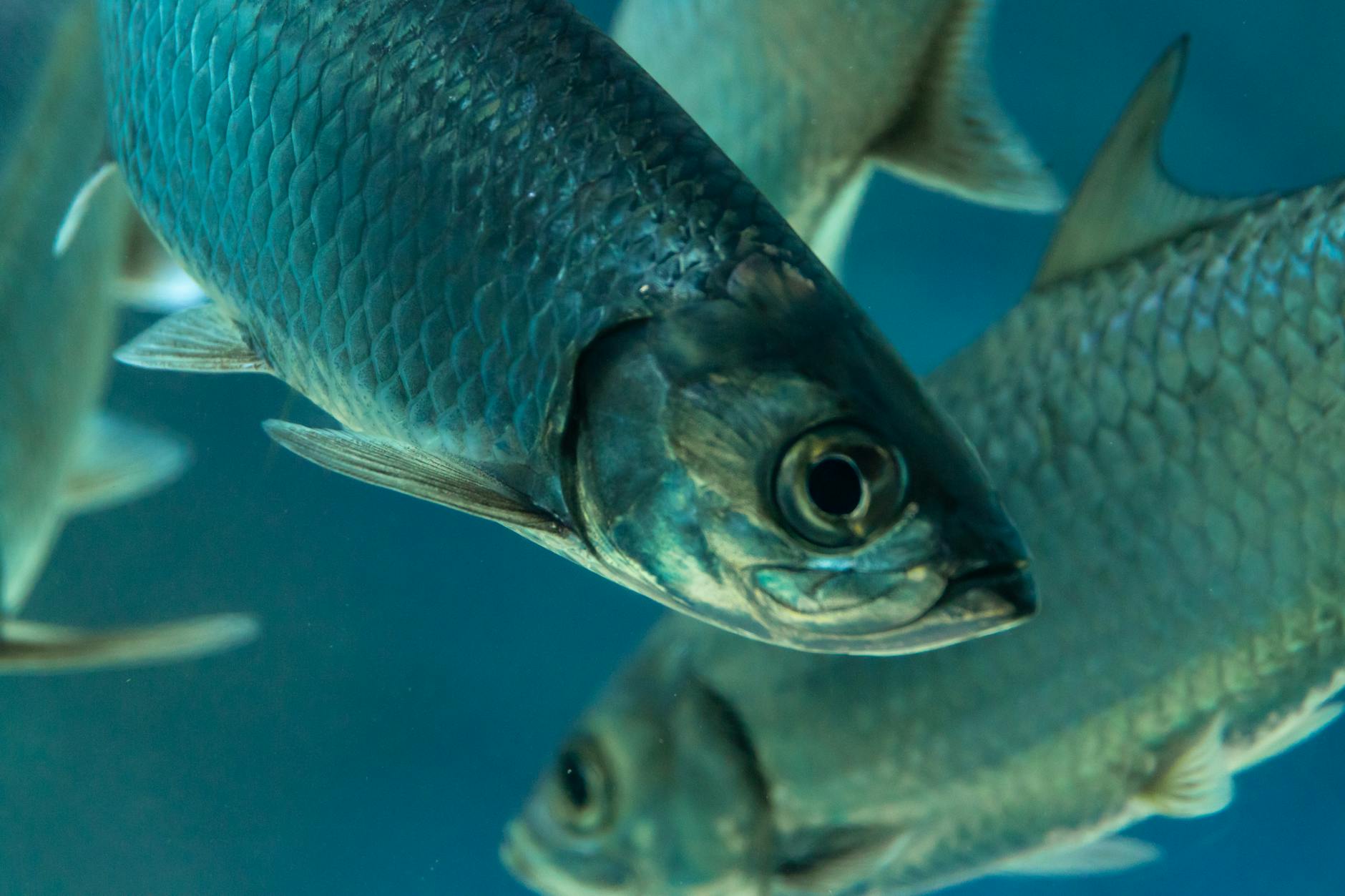
Strip away the T-shirts and the reputation and it is very simple. You pay a couple of dollars to walk out onto a wooden dock over the bay, you buy a small bucket of baitfish, and you feed them to a resident school of wild Atlantic tarpon that has learned, over several generations of fish, that this particular dock is where the free lunch is. There is no tank, no net and no enclosure. The tarpon are free to leave, and some days fewer of them bother to turn up. Most days, a great many do — the marina’s own count is more than a hundred fish in the water around the docks.
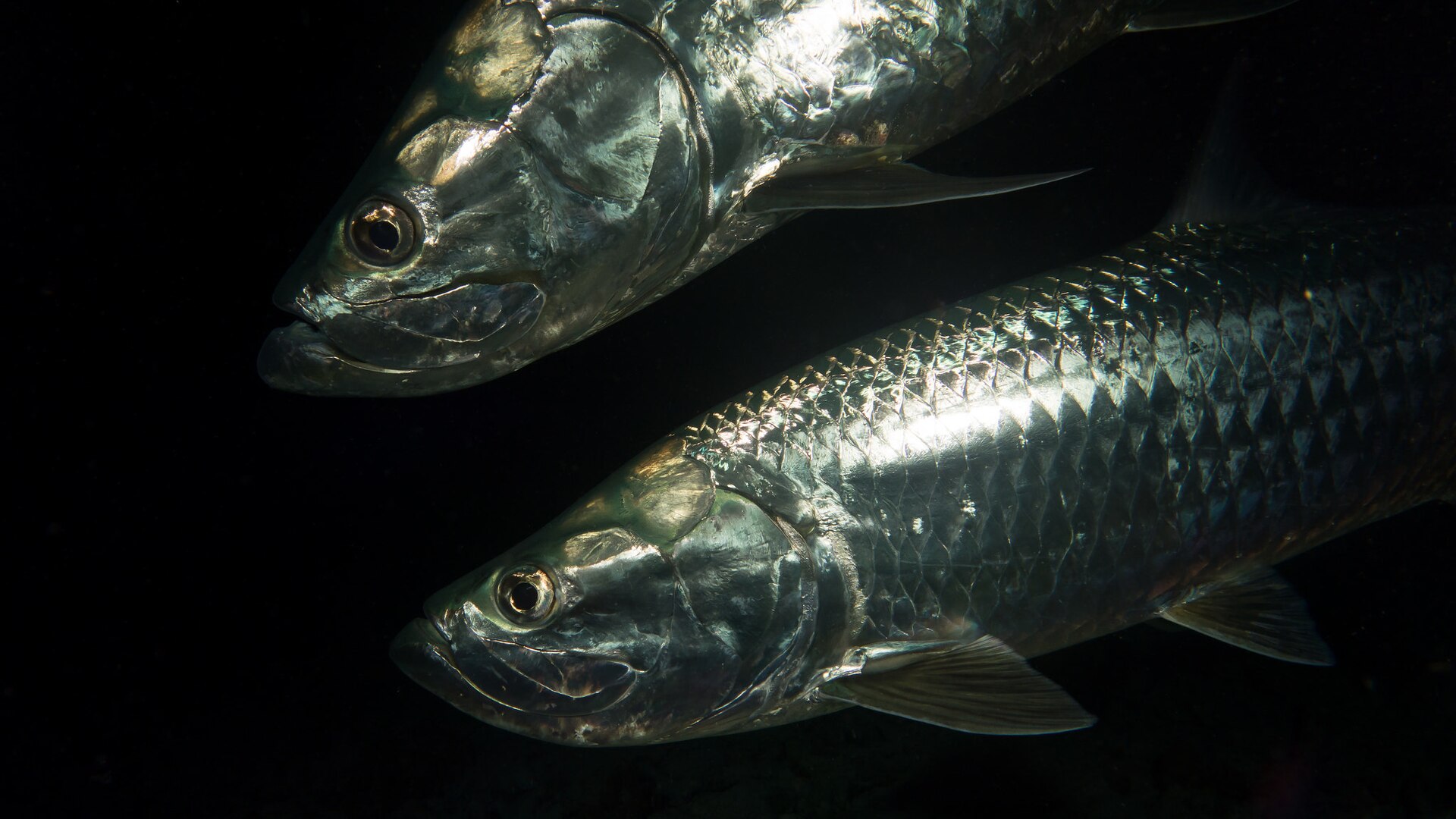
These are not small fish. The tarpon at Robbie’s typically run four to six feet long, and the big ones are well over a hundred pounds. They are prehistoric-looking animals with huge, armor-plated scales, an upturned bucket of a mouth and a single, enormous eye that seems to follow the bait. In the rest of the Keys, anglers pay several hundred dollars for a guide and a day on the flats in the hope of hooking one. At Robbie’s you are looking down at dozens of them from three feet away for the price of a coffee.
How it came to be
The story the marina tells, and has been telling for decades, is that the original Robbie found an injured tarpon near the dock, nursed it back to health in a holding pen and fed it by hand until it was well enough to release. The fish, the story goes, kept coming back, and it brought friends. Whether every detail of that is literally true matters much less than what followed: a tarpon school that has been reliably fed at the same dock since the 1970s, a few curious tourists who became a steady stream, and a working bait-and-boat marina that slowly turned into one of the most visited stops between Key Largo and Key West.
It is worth knowing that tarpon are a strictly protected catch-and-release species in Florida. Killing or keeping one requires a special tag and is only permitted in pursuit of a record. The fish at Robbie’s are not farmed, not captive and not going anywhere near a dinner plate, which is a large part of why they have become so relaxed about people.
How to feed the tarpon (and keep your fingers)
Pay at the booth at the land end of the dock. You get a wristband or a stamp for the admission and a small plastic bucket of fish, usually somewhere between five and eight baitfish depending on their size. That sounds like a lot. It is not. A bucket lasts about three minutes if you are careful and about forty seconds if you are nine years old.
- Take one fish by the tail. Hold it at the tail end rather than the middle, so the head hangs down toward the water.
- Kneel or crouch at the edge of the dock. Leaning over from standing height puts your face and your phone in the splash zone, and the splash is considerable.
- Hold the fish a foot or so above the surface. Keep it still. The tarpon will locate it; you do not need to wave it about.
- Let go when the fish comes up. A tarpon feeds by opening its mouth and sucking in a huge volume of water along with the bait. It does not bite the way a shark does, but the inside of its mouth is rough, like coarse sandpaper, and if you hold on too long it will scrape your knuckles on the way down.
- Watch your bucket between throws. This is the part everyone gets wrong, and it is the subject of the next section.
The braver, or more stubborn, method is to hold the fish lower, a few inches from the water, and let the tarpon take it from your hand. Staff and regulars do it all the time. It is not dangerous in any serious sense, but you will get wet, you may get a scraped hand, and a small child should not try it without an adult’s hand around theirs.
The pelican problem
The brown pelicans at Robbie’s are the real professionals on the dock. They have watched this happen thousands of times, and they have worked out that the most efficient way to get a fish is not to compete with the tarpon in the water but to take it from you before you throw it. A pelican will reach over your shoulder and pluck a sardine out of your hand, or put its whole bill into your bucket while you are lining up a photo. They are large birds with a long, hooked bill, and while they are not aggressive in the way a gull on a boardwalk is, a toddler with a bucket of fish is a very attractive target.
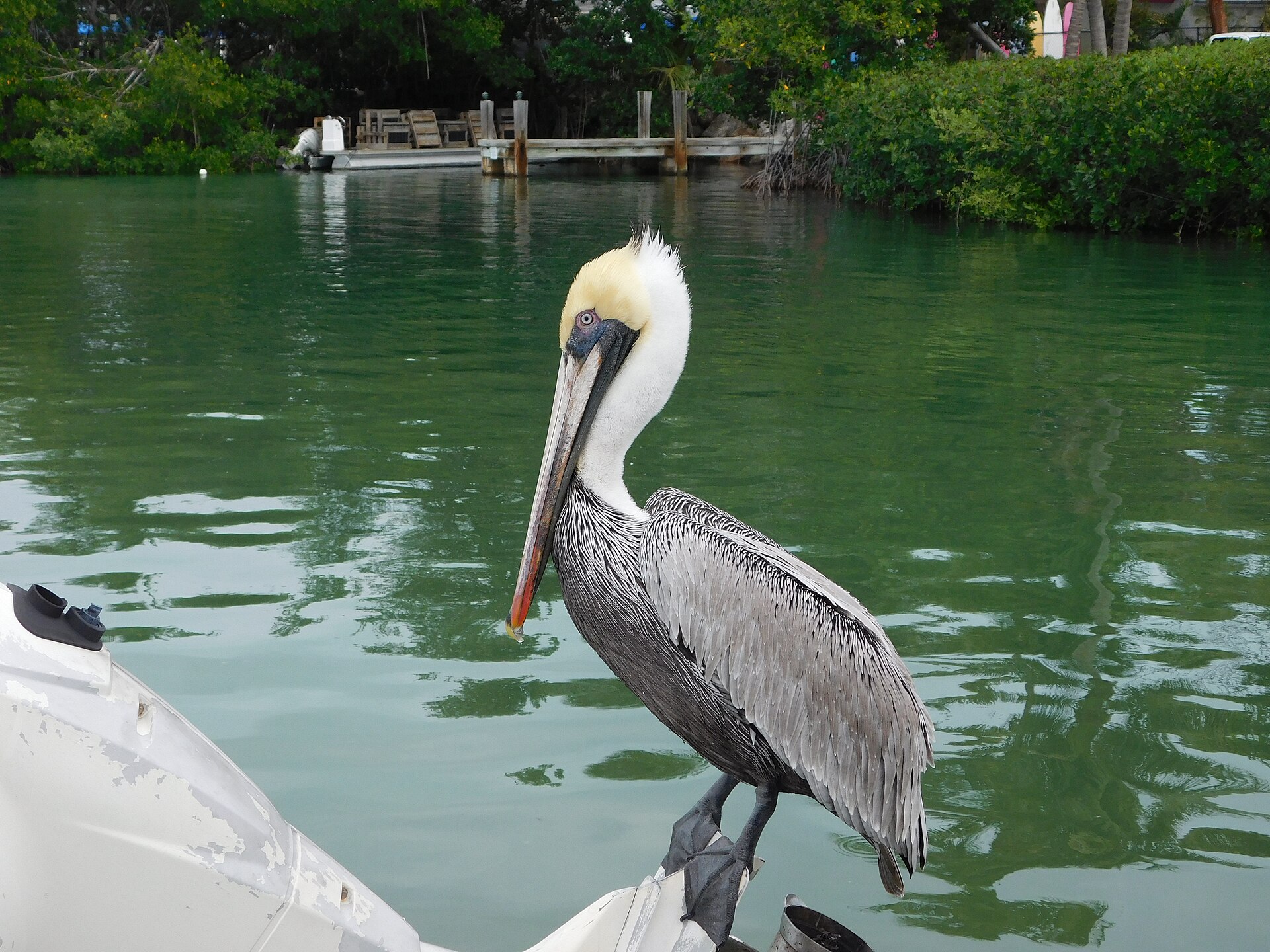
Robbie’s posts signs asking visitors not to feed the pelicans, and there are good reasons for it: fish fed to birds by hand teach them to associate people with food, and baitfish swallowed whole, or with a hook still in them elsewhere on the island, injure birds every year. Practically, that means:
- Keep the bucket on the dock between your feet, not in your hand.
- Take one fish at a time and feed it straight away.
- If a pelican gets hold of the fish, let it go. Do not wrestle a bird for a sardine.
- Do not hold the bucket up for a photograph. That is an invitation.
- With small children, an adult holds the bucket and hands over one fish at a time.
Is it safe for kids?
Yes, with sensible supervision, and it is one of the best-value things to do with children anywhere in the Keys. The dock has rails, the tarpon never leave the water, and a five-year-old will be talking about the big splashy fish for the rest of the week. The real hazards are ordinary ones: a wet, slippery dock, a small child leaning too far over the edge, and pelicans. Wear shoes with grip rather than flip-flops, keep toddlers on the inside of the dock, and bring hand wipes — you will smell of sardine until you find a sink.
Pets, however, are not allowed on the feeding dock, for their safety and the wildlife’s. A dog lunging at a pelican on a narrow dock over deep water is not anyone’s idea of a good afternoon.
When to go
Time of day
The marina opens at 7:00 a.m. and the Hungry Tarpon starts serving breakfast at 6:30. The first hour is the best hour. The light on the bay is soft, the dock is nearly empty, the tarpon have not been fed by several hundred people yet and are correspondingly enthusiastic, and you can take your time. By 11:00 on a winter Saturday the dock is shoulder to shoulder, you are queuing for a gap at the rail, and a large proportion of the fish in the water have eaten their fill.
Late afternoon is the second-best window, especially if you are driving south and want a break before the long run to Key West. From about 4:00 p.m. the day-trippers from Miami start heading home, and the light across the flats toward Lignumvitae Key turns gold.
Time of year
The tarpon at the dock are there all year, and the feeding runs every day the marina is open. The wider tarpon season in the Keys peaks from spring into early summer, when migrating fish pour through the bridges and channels — that is when the anglers flood in, and it is the subject of our Key West tarpon fishing guide. At Robbie’s the resident school makes the season almost irrelevant. What changes with the calendar is the crowd, and the heat on an unshaded dock in August.
| Season | Crowds | Conditions | Verdict |
|---|---|---|---|
| Mid-December to April | Busiest, especially weekends and spring break | Mild, dry, breezy | Go early in the morning |
| May to June | Moderate | Hot, calm, peak tarpon migration in the channels | Excellent all round |
| July to September | Quieter on weekdays | Very hot and humid, afternoon storms | Go at 7:00 a.m. or not at all |
| October to mid-December | Quiet | Warm, hurricane risk into November | Easy, uncrowded, check the weather |
What else is at Robbie’s
The tarpon are the reason people stop, but Robbie’s is a working marina, and most of what it does is get people out onto the water. If you are basing yourself in Islamorada for a few days rather than passing through, it is one of the most convenient places in the Middle Keys to book a trip. For the town as a whole — the sportfishing, the restaurants, the hurricane history and the traffic — see our full Islamorada guide.
Party boat fishing
Captain Michael runs the marina’s party boat, a large, stable, shared-charter vessel that suits families, first-timers and anyone who wants to catch fish without paying for a private boat. Rod, reel, bait and tackle are included; you pay per person.
| Trip | Times | Price per person |
|---|---|---|
| Morning | 9:00 a.m. – 2:00 p.m. | $100 |
| Afternoon | 2:30 p.m. – 6:30 p.m. | $75 |
| Night | 7:30 p.m. – 12:30 a.m. | $100 |
The afternoon trip is the best value and the easiest on children. The night trip is a genuine experience — the reef after dark is when snapper feed hardest — but it finishes at half past midnight, and that is a long day for anyone under twelve. Budget for a tip for the mates, who do the baiting, untangling and filleting, and ask before you go whether they will clean and bag your legal catch. The way party boats work, and when they are worth it compared with a private charter, is covered in our Key West party boat fishing guide; the Islamorada boats follow the same model.
Snorkel trips
Snorkel boats leave the marina twice a day, at 10:00 a.m. and 1:30 p.m., running out to the reef tract on the Atlantic side. The morning departure generally has calmer water; afternoon wind builds on many days, particularly in winter. Smaller groups of six or fewer can book a private trip through KeyZ Charters, which operates from the marina. Islamorada’s reefs are less famous than John Pennekamp’s to the north, but sites such as Alligator Reef, with its offshore lighthouse, are superb in the right conditions, and the boats are rarely as crowded. Our Key West snorkeling guide covers what gear and fitness you need, and much of it applies equally here.
Kayaks, paddleboards and the two islands offshore
Robbie’s rents kayaks and paddleboards and runs guided paddles. On a calm morning this is the best thing to do here after the tarpon, because two of the most interesting islands in the Keys are within paddling range:
- Lignumvitae Key Botanical State Park, on the bay side. A virgin tropical hardwood hammock that has never been cleared — gumbo limbo, poisonwood, strangler fig and the rare lignum vitae tree it is named after — with a 1919 limestone house. Access is by boat or kayak only, and the interior is visited on ranger-led walks on a limited schedule, so check the Florida State Parks listing before you paddle out expecting to explore.
- Indian Key Historic State Park, on the ocean side. A tiny island that was briefly the county seat in the 1830s, a wrecking settlement that was attacked and burned in 1840. Today it is ruins, cisterns, an observation tower and a trail laid over the old street plan. It is a longer, more exposed paddle, and not one to start in a building easterly wind.
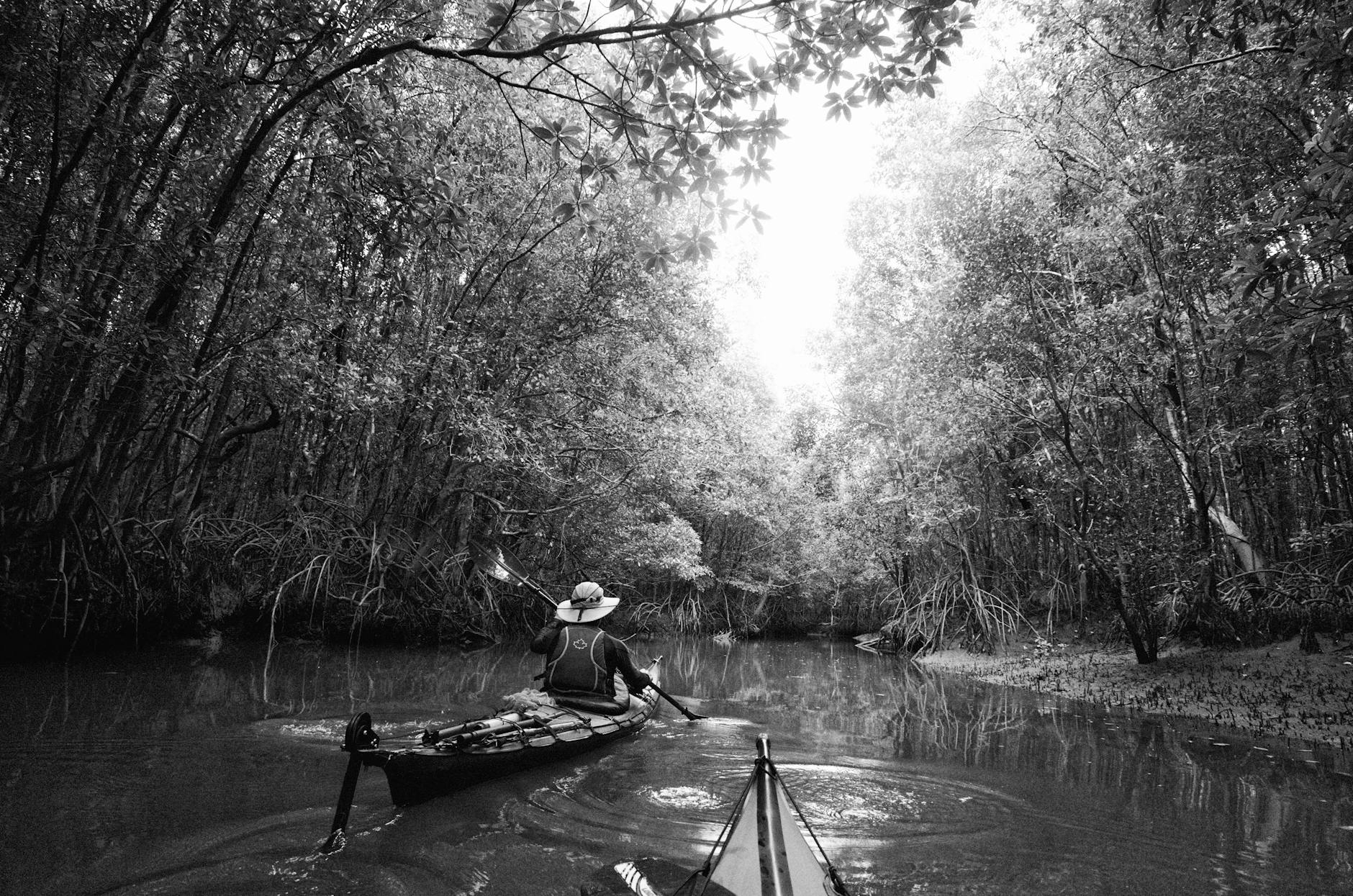
Be honest with yourself about the conditions. The water around the marina is shallow and beautiful, but it is open water with boat traffic in the channels, and the wind in the Keys can rise from a flat calm to a steady 15 knots within an hour. If you are not an experienced paddler, a guided trip is money well spent. For more on paddling routes and what to expect, see our Key West kayaking guide.
Boat rentals, jet skis, parasailing and sandbar trips
The marina also books boat rentals, jet ski tours, parasailing, sunset cruises, SNUBA and sandbar trips. Prices for these move with the season and the operator, so ask at the booth or call ahead. If you are renting a boat yourself for the first time in Keys waters, go out on a rising tide, stay in marked channels and keep a chart open — the flats around Islamorada are among the easiest places in Florida to run aground, and towing is expensive.
The Hungry Tarpon
The restaurant on the water at Robbie’s is open for breakfast, lunch and dinner, from 6:30 a.m. to 9:00 p.m. It is an honest, casual, open-air Keys fish house with tables under the trees looking over the docks, and it is at its best at breakfast, when you can watch the tarpon feeding start while you drink your coffee. It gets busy at lunchtime in season. It is not the best restaurant in Islamorada, and it is not trying to be; it is a pleasant, useful place to eat that happens to have one of the best views in the Middle Keys.
The open-air market
Between the parking lot and the docks, Robbie’s Tropical Open Air Market is a cluster of stalls and small shops selling local art, jewelry, beach clothing and the inevitable tarpon souvenirs. Some of it is genuinely good local work. A lot of it is the same printed T-shirt available in every shop on Duval Street. Browse, but do not set aside an hour.
Is Robbie’s worth it?
The honest answer is that the tarpon feeding is one of the best-value experiences in the whole of the Florida Keys, and almost everything else at Robbie’s is fine rather than special.
For $7.50 per person — admission plus one bucket — you get a close-up encounter with a large, wild, genuinely impressive gamefish that people travel from all over the world to catch. There is no line to get into a theater, no timed ticket, no gift shop exit. Children love it, adults who would never admit to being excited about a fish get excited, and it takes about thirty minutes. As a stop on the drive between Miami and Key West, it is hard to beat.
Where it falls short is when people expect more from it than it is. It is a busy, slightly scruffy, sun-bleached marina, not an attraction with landscaped paths and interpretive signs. At 11:00 on a Saturday in March the dock is crowded, the pelicans are pushy, you will wait for a spot at the rail, and it smells exactly like a bait dock should. If you want an organized, educational marine experience for a family, Theater of the Sea a few miles up the road at MM 84.7 is a more structured day out — at a far higher price. For the broader range of options on the island chain, our Key West family activities guide sets them side by side.
| Activity | Cost | Worth it? |
|---|---|---|
| Tarpon feeding (admission + one bucket) | $7.50 | Absolutely — the reason to stop |
| Second bucket | $5 | For children, yes; one is enough for most adults |
| Afternoon party boat | $75 | Good value for families and beginners |
| Morning or night party boat | $100 | Worth it if fishing is the point of your day |
| Snorkel trip | Check current fare | Yes, on a calm morning |
| Kayak rental | Check current rate | Yes, if the wind is light |
| Breakfast at the Hungry Tarpon | Casual-restaurant prices | Yes, for the view and the early tarpon |
| Browsing the market | Free | Twenty minutes, not more |
Getting there and parking
Robbie’s is on the bayside (the right-hand side heading south, the left heading north) at MM 77.5, at the southern end of Islamorada, just before the long bridges toward Long Key. The turn comes up quickly after a stretch of water on both sides of the highway; slow down as the mile markers pass 78 if you are southbound. There is a free parking lot, which fills in the middle of the day in season. Traffic through Islamorada is slow at the best of times, and the left turn back onto US 1 northbound on a busy afternoon can take a few minutes.
- From Key West: about 77 miles, allow 1 hour 45 minutes to 2 hours. A classic half-way stop on a drive up the Keys, or a destination in itself on a day out. Our Key West day trips guide covers building a full day around it.
- From Key Largo: about 25 to 30 miles, 35 to 45 minutes. See our Key Largo guide if you are staying at the top of the chain.
- From Marathon: about 25 miles southwest, 30 to 40 minutes. The Marathon guide covers what to combine it with.
- From Miami: roughly 90 miles, 2 hours or more. The route and the stops are in our drive to Key West guide.
What to bring
- Shoes with grip — the dock gets wet
- Sunscreen, a hat and water; there is little shade on the dock itself
- Cash as a backup for small purchases, though cards are widely taken
- Hand wipes or sanitizer for after the feeding
- A phone strap or a firm grip — phones do go into the water here
- Polarized sunglasses, which make it far easier to see the fish under the surface
A half day in Islamorada built around Robbie’s
If you are staying in Islamorada or passing through with time to spare, this is a relaxed, very Keys way to spend a morning:
- 7:00 a.m. — Arrive as the booth opens. Feed the tarpon before anyone else is on the dock.
- 7:45 a.m. — Breakfast at the Hungry Tarpon, looking out over the water.
- 8:45 a.m. — Pick up kayaks and paddle toward Lignumvitae Key while the water is still flat, or join the 10:00 a.m. snorkel boat.
- 12:00 p.m. — Back on land. Twenty minutes in the open-air market.
- 12:30 p.m. — Drive a few miles north to the Hurricane Monument at MM 81.6, then lunch at one of Islamorada’s dockside restaurants.
Heading south toward Key West instead, the next unmissable stretch is the Seven Mile Bridge, about 30 miles down the road, with the Turtle Hospital in Marathon on the way.
Frequently asked questions
How much does it cost to feed the tarpon at Robbie’s?
Dock admission is $2.50 per person, valid once per day, and each bucket of fish costs $5.00. A single visitor feeding the tarpon pays $7.50 in total. Anyone who just wants to watch pays the $2.50 admission only. Prices checked September 2026.
What are Robbie’s hours?
Robbie’s Marina and the tarpon booth are open daily from 7:00 a.m. to 9:00 p.m. The Hungry Tarpon restaurant opens slightly earlier, at 6:30 a.m., and also closes at 9:00 p.m.
Do the tarpon bite?
Not in the way people fear. A tarpon has no large teeth; it inhales its food along with a mouthful of water. The inside of its mouth and its jaw are very rough, though, and if you hold on to the fish as the tarpon takes it you can come away with scraped knuckles. Hold the bait by the tail and let go as the fish rises.
Can you keep a tarpon you catch in Florida?
Effectively no. Tarpon are catch-and-release in Florida, and possession requires a special tag intended only for pursuing a state or world record. The tarpon at Robbie’s are wild fish living free in the bay.
Is Robbie’s good for children?
It is one of the best stops in the Keys for children, and one of the cheapest. Supervise them closely at the edge of the dock, have an adult hold the bucket so the pelicans do not raid it, and put them in shoes with grip.
Can I bring my dog to Robbie’s?
Robbie’s is dog-friendly in general, but pets are not allowed on the tarpon feeding dock itself. Plan for one adult to wait with the dog while the others feed the fish.
Where exactly is Robbie’s of Islamorada?
77522 Overseas Highway, Islamorada, on the bayside at Mile Marker 77.5, at the southern end of Islamorada. It is roughly 77 miles from Key West and about 90 miles from Miami.
Is Robbie’s worth the stop if we are driving straight to Key West?
Yes. It adds about 30 to 45 minutes to the drive, costs very little, gets everyone out of the car at roughly the halfway point, and is far more memorable than a gas station. Go before 10:00 a.m. or after 4:00 p.m. to avoid the worst of the crowds.
Related Key West Guides
- Islamorada guide — the whole village, from sportfishing to the hurricane monument
- Key West tarpon fishing — chasing the silver king with a rod, a guide and a lot of patience
- Key West family activities — what else children love at the end of the road
- The Florida Keys beyond Key West — every island on the chain, mile marker by mile marker
- Key West party boat fishing — how shared fishing trips work and whether they pay off
- Key West kayaking — paddling the mangroves and flats
- Drive to Key West — the Overseas Highway and the best stops along it
Photo Credits
Feeding the tarpon at Robbie’s dock: Florida Keys Scenic Highway – Tarpon Feeding – NARA – 7718455 by Unknown author Unknown author or not provided, Public domain, via Wikimedia Commons.
Brown pelican in Islamorada: Islamorada – Florida Keys (51800503752) by Joseph Gage from Yorkville, IL, USA, CC BY-SA 2.0, via Wikimedia Commons.
Atlantic tarpon underwater: Atlantic Tarpon Megalops Atlanticus (251803267) by Kris Mikael Krister, CC BY 3.0, via Wikimedia Commons.
Sources & corrections
Rates, hours and closures verified against operator listings and on-island visits. Prices are peak-season unless noted.