Sheet 07 · Florida Keys
Key Deer of Big Pine Key: Where and When to See Them
Where to find Key deer on Big Pine and No Name Key, the hours that actually work, why feeding them kills them, and how to photograph a dog-sized endangered deer standing on somebody's lawn.
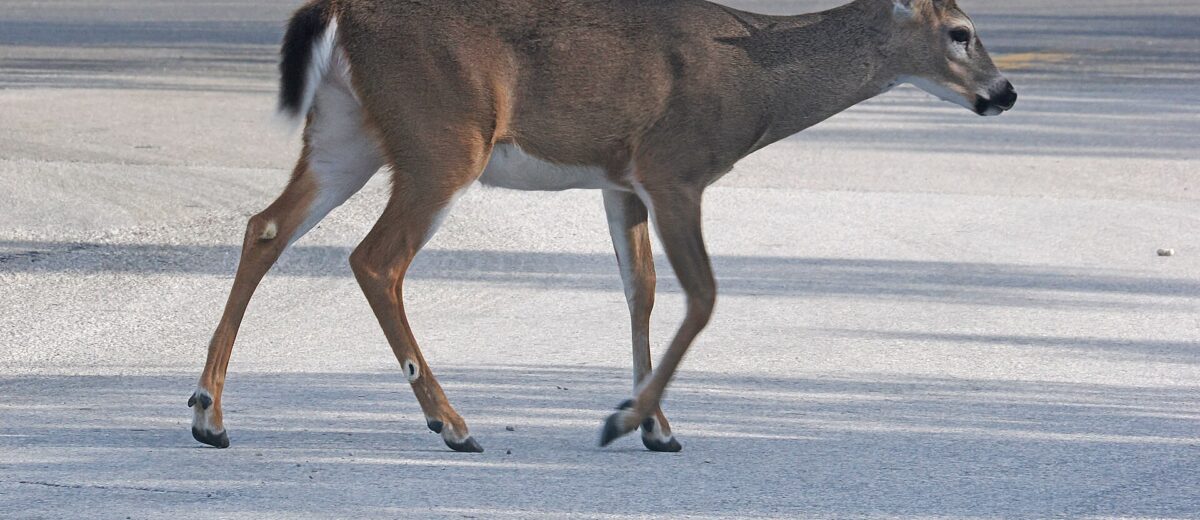
The first one you see is always smaller than you expected. Photographs cannot convey it: an adult stands about thirty inches at the shoulder, roughly the height of a golden retriever, with the proportions and the face of a full-grown white-tailed deer scaled down by a third. Then it walks out onto Key Deer Boulevard, stops in the middle of the lane, and looks at your windshield with no alarm whatsoever, and you understand why Key deer are still on the endangered species list nearly seventy years after somebody set up a refuge to save them.
This guide covers where and when to see them, how not to harm them, what the refuge is actually like to visit, and the honest expectation-setting nobody does — because these are not shy woodland animals you stalk for hours. Details were checked in September 2026; posted speed limits and refuge access can change, so read the signs on the day.
At a glance
| Question | Answer |
|---|---|
| Where | Big Pine Key (MM 29–33) and No Name Key, Lower Florida Keys |
| Best time of day | First light to about 9:00 a.m., and 5:30 p.m. to dusk |
| Best roads | Key Deer Boulevard, Watson Boulevard, No Name Key, Long Beach Road |
| Cost | Free — the refuge charges nothing |
| Population | Roughly 700 to 800 animals |
| Size | About 30 inches at the shoulder, 55 to 75 pounds |
| Refuge size | 84,351 acres across 25 islands, established 1957 |
| Speed limits, US 1 on Big Pine | 45 mph day, 35 mph night, MM 29.5–33 — camera-enforced |
| Chance of seeing one at dawn | Very high — better than 80 percent on the right roads |
| Feeding | Illegal, and the single worst thing you can do to them |
What a Key deer actually is
Odocoileus virginianus clavium is an endemic subspecies of white-tailed deer found nowhere on earth but the Lower Florida Keys. The ancestors walked down the peninsula when sea level was lower and the Keys were connected to the mainland; when the water rose after the last glaciation, a few hundred animals were left on a handful of small islands with limited fresh water and limited browse. Over the following several thousand years, they got smaller — a textbook case of insular dwarfism, the same evolutionary pressure that produced dwarf elephants on Mediterranean islands.
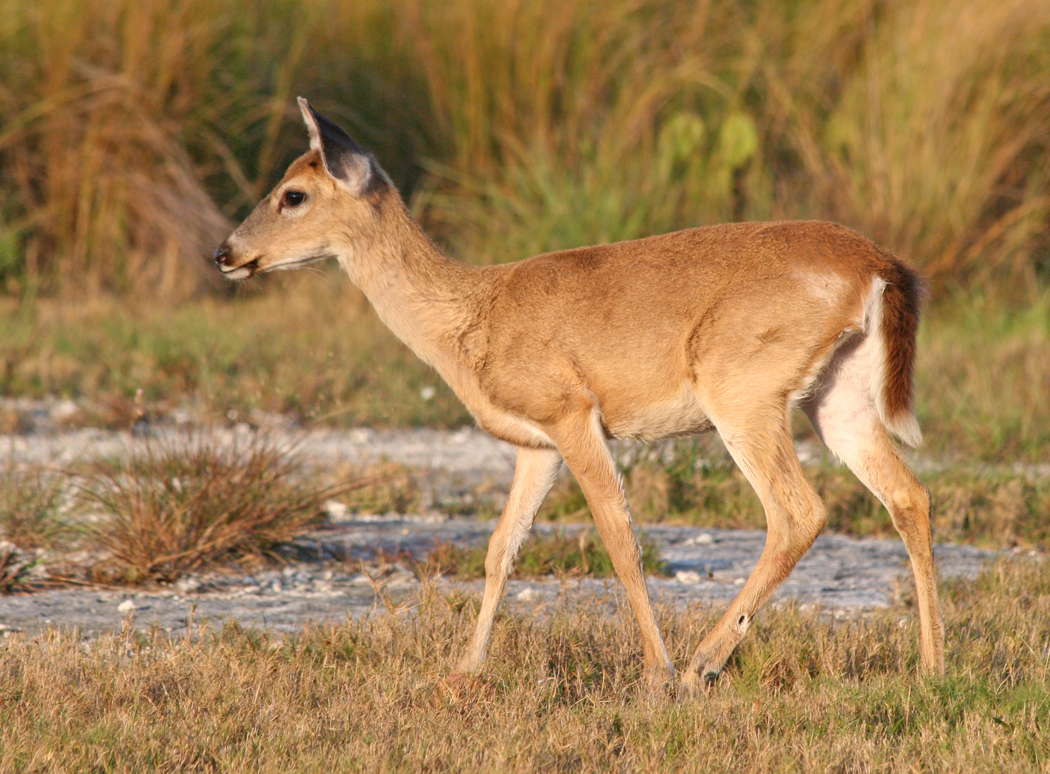
The numbers: bucks weigh 55 to 75 pounds, does 45 to 65, and they stand 24 to 32 inches at the shoulder against 36 to 42 for a mainland white-tail. Bucks grow small antlers and shed them in spring. Fawns are the size of a house cat and weigh two to four pounds at birth, and they are unbearably small.
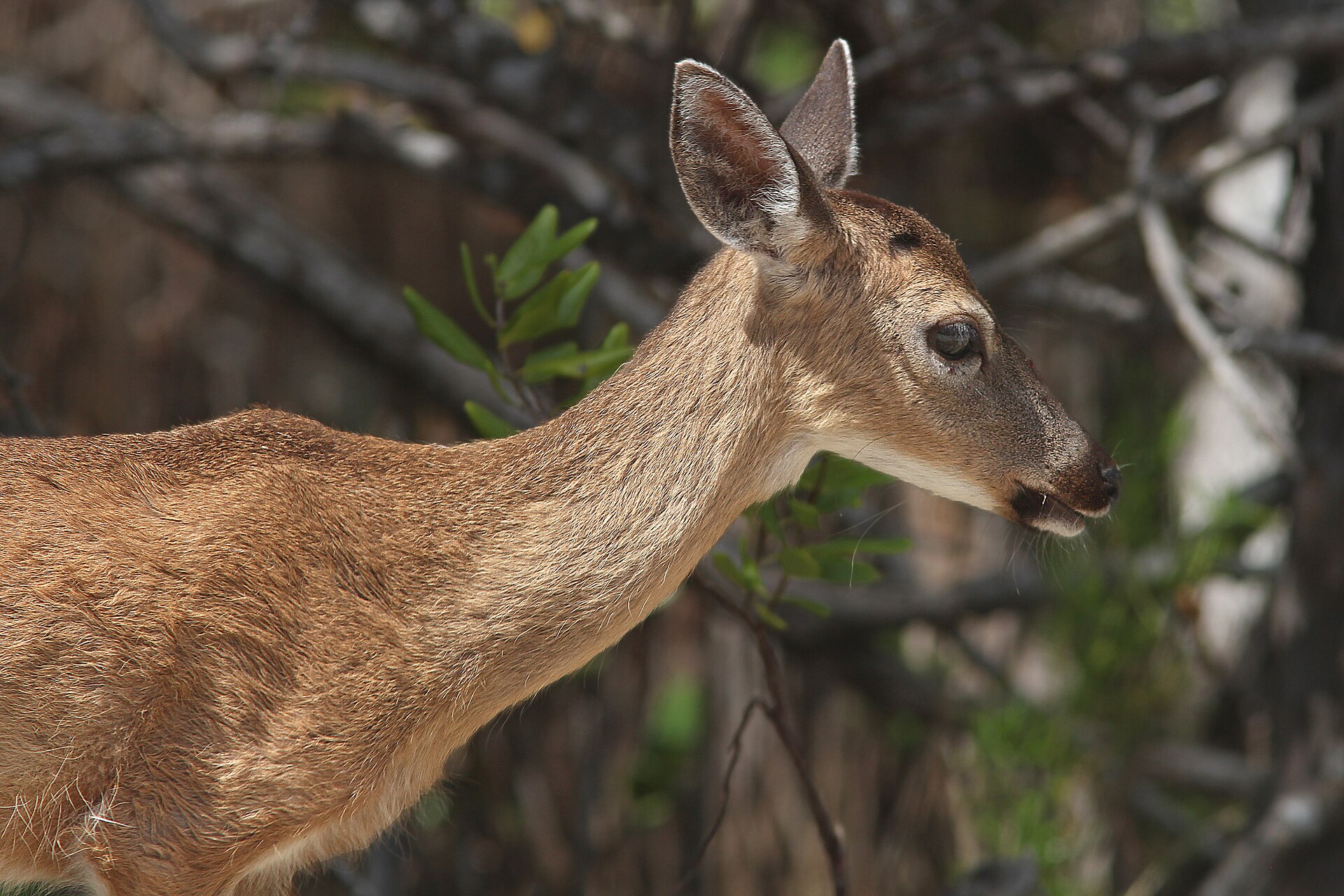
They browse over 160 species of plant, favoring red, black and white mangrove, thatch palm berries, silver palm and native grasses. They swim readily between islands. And critically, they depend on the freshwater lens that sits above the salt water inside Big Pine’s oolitic limestone — the only substantial fresh water in the archipelago, and the reason the deer survive here and nowhere else in the chain.
The refuge, and how close the species came to going
By the late 1940s hunting, poaching, road kills and habitat loss had cut the population to somewhere between 25 and 50 animals. A Boy Scout named Glenn Allen wrote letters. A conservationist named Jack Watson — later the refuge’s first manager, and by all accounts a formidable man who slashed poachers’ tires and burned their vehicles — pushed the case publicly. Congress authorized the National Key Deer Refuge in 1957.
It worked. The population recovered into the several hundreds and today stands at roughly 700 to 800 animals across 84,351 acres and 25 islands. The subspecies remains federally listed as endangered, and the reasons are worth knowing: the total range is a few small islands whose highest ground is a couple of feet above sea level, sea level is rising, and the freshwater lens they depend on shrinks as salt water intrudes. A single major hurricane can take out a quarter of the population — Irma in 2017 killed a substantial number outright — and in 2016 an outbreak of New World screwworm, a parasitic fly whose larvae feed on living tissue, killed an estimated 135 deer before a sterile-fly release program stopped it.
None of that is a reason to feel gloomy on your visit. It is a reason to take the rules seriously.
Where to see them
Key Deer Boulevard
The main road north from US 1 into the refuge, and the most reliable place in the world to see a Key deer. Drive it slowly at first light or in the last hour before dark, with the windows down. They browse on the verges, in the side streets of the residential areas, and on the mown edges of the road. You will very likely see several.
No Name Key
Cross Watson Boulevard and the little bridge onto No Name Key — an island with a handful of houses, no commercial anything, and a high deer density. It is quiet, the road is narrow, and the light at dawn coming through the pines is the best photography of the trip. This is also the route to the No Name Pub, which means the drive out to dinner is itself the wildlife tour.
Long Beach Road
Off the southern side of US 1, running out along the shore. Less traveled, good for deer and good for wading birds, and it ends at a small shoreline where you can watch the sunset.
The Blue Hole and the trails
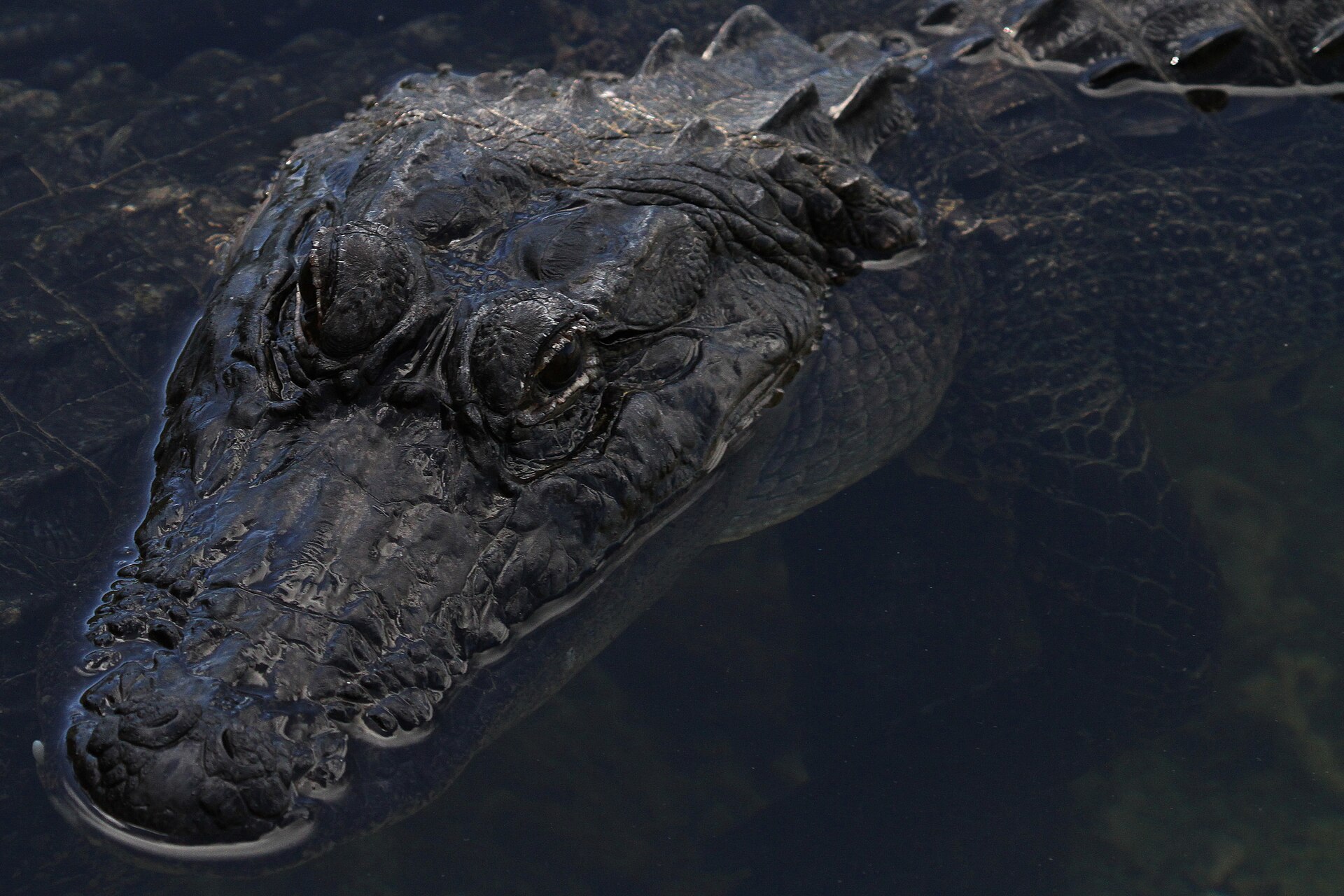
Two miles up Key Deer Boulevard is the Blue Hole, a flooded quarry that is the largest body of fresh water in the Keys and reliably holds alligators, turtles and wading birds from its observation platform. Deer come to drink here, particularly in dry spells, and the Jack Watson and Fred Mannillo trails nearby are short walks through pine rockland where you have a decent chance of an encounter on foot. The Mannillo trail is a wheelchair-accessible boardwalk. Everything here is free.
The residential streets
Worth saying plainly: a great many of the deer people photograph are standing on somebody’s lawn. Big Pine’s neighborhoods are inside the refuge and the deer treat them as habitat. Drive slowly, do not block driveways, do not photograph into people’s windows, and remember that the residents deal with visitors doing exactly this every single day of the year.
When to go
Time of day matters far more than season. Key deer are crepuscular — most active at dawn and dusk — and in the middle of a hot afternoon they are lying up in shade and you may see nothing at all. Aim for the hour after sunrise or the hour before sunset.
- Dawn is the best: cooler, quieter, almost no traffic, and the deer are out on the verges. Also the safest time to be driving slowly on those roads.
- Dusk is nearly as productive and considerably more dangerous, because it is when most vehicle strikes happen. Headlights on, 35 mph, both eyes on the shoulders.
- Fawning season runs April through June, peaking around April and May. Fawns are minute and the does are more defensive than usual.
- The rut is September through November, when bucks move more, cross roads more, and pay less attention. Strike numbers rise.
- Winter — December through April — is the pleasant season for a visitor: no mosquitoes, cool mornings, dry roads. Summer works too, but bring serious repellent; Big Pine has the worst insects in the chain because it has the only freshwater wetlands.
The rules, and why each one exists
Do not feed them. Ever.
This is the one that matters and it is the one visitors break most, usually out of affection. Feeding a Key deer is illegal under federal law, and the harm is not abstract:
- A fed deer learns that vehicles mean food, so it walks toward the road instead of away from it, and then it is hit. Vehicle strikes are the leading cause of death in the population.
- It loses its fear of people, and habituated deer get into gardens, get chased by dogs, and end up being destroyed as nuisances.
- Human food makes them ill. Their digestive systems handle mangrove and native browse, not bread, corn or apples. Bloat and rumen acidosis kill deer.
- It concentrates animals, which spreads disease through a population already small enough that a single outbreak is an existential problem.
If you see somebody feeding one, they are not being kind. Refuge staff will tell you the same thing in blunter terms.
Drive as if there is a deer behind every bush
Forty-five miles an hour by day and thirty-five at night on US 1 through Big Pine, from MM 29.5 to MM 33, and it is enforced by camera. Lower on the side roads. Slow down for the underpasses and the fencing near MM 30 — those were built specifically to funnel deer beneath the highway, and animals congregate at the ends of them. Scan the shoulders rather than the lane, and if you see one deer, expect a second: they move in small groups and the one you have not seen yet is the one you hit.
Keep your distance, and keep your dog on a lead
Twenty-five yards is a reasonable rule. A deer that stops eating and looks at you is already too close. Free-running dogs chase deer, and chased deer run onto roads. Dogs must be leashed throughout the refuge.
Report an injured animal
Do not attempt to move or help a struck deer yourself. Call the Monroe County Sheriff or the Florida Fish and Wildlife Conservation Commission’s wildlife alert line, and note the mile marker. If you hit one, stop and report it — that data drives where the next set of fencing and underpasses goes.
The other wildlife you will see while looking for deer
Nobody drives Key Deer Boulevard at dawn and sees only deer. The pine rockland and freshwater wetlands on Big Pine support a list of species that exists nowhere else in the chain, and several of them are as rare as the deer.
- Lower Keys marsh rabbit — a federally endangered subspecies, once given the scientific name Sylvilagus palustris hefneri after the magazine publisher who funded the research. Small, dark, and most often seen at dusk in the wet margins.
- Great white heron — a white morph of the great blue heron that is essentially confined to South Florida and the Keys. Standing four feet tall on a canal bank, it is unmistakable.
- White-crowned pigeon — a threatened Caribbean species that nests on the backcountry mangrove islands and flies in to feed on hardwood hammock fruit.
- Roseate spoonbills on the shallow flats, particularly at first light. Pink, absurd, and entirely worth stopping for.
- American alligators at the Blue Hole, and nowhere else in the archipelago.
- Silver rice rat, Key ringneck snake, Florida Keys mole skink — three more endemics you are unlikely to see but which explain why 84,000 acres are protected here.
Take binoculars if you have them. The best twenty minutes of a Big Pine morning is often spent standing still at the Blue Hole platform rather than driving.
Photographing them
They are easy to photograph badly and harder to photograph well, because the temptation is to get close and the interesting picture is elsewhere.
- A telephoto lens, or a phone with real optical zoom. Getting closer degrades the animal’s behavior and the photograph.
- Shoot at the animal’s eye level if you can do it from the car window. Shooting down at a small deer makes it look like a lawn ornament.
- Golden hour is not a cliché here — the low light through slash pine on No Name Key at 7:00 a.m. is the reason to be up.
- Include the context. A deer on a residential street, at a stop sign, beside a mailbox, tells the true story of this species far better than a portrait in scrub does.
- No flash, no drones, and do not use food, sound or movement to make an animal look up. Baiting for a photograph is the same offense as feeding.
- Stay in the car where you can. It is a better hide than anything you could build, and the deer are entirely relaxed about vehicles that are not approaching them.
Making a trip of it
A deer-watching visit is an hour, and Big Pine gives you the rest of a good day around it. Dawn on Key Deer Boulevard and No Name Key, then the Blue Hole and the Watson and Mannillo trails, then breakfast on the highway. Mid-morning is the moment to be on the water — the mangrove paddling off the Torch Keys and Sugarloaf is the best in the chain — or twelve minutes east at Bahia Honda State Park for the beach. Come back to the refuge roads at 6:00 p.m., then pizza at the No Name Pub under its ceiling of stapled dollar bills.
Our Big Pine Key and Lower Keys guide covers where to stay, eat and paddle, and the Key West eco tours guide covers the guided version of the wildlife day from the southern end. For families, the deer are one of the genuinely great wildlife encounters available to a child in the United States, and our Key West with kids guide sets out the rest of the family itinerary down the chain.
The honest verdict
This is one of the best and easiest wildlife experiences in Florida, it costs nothing, and if you drive Key Deer Boulevard at seven in the morning you will almost certainly see several animals within twenty minutes. As a wildlife encounter with a species that exists nowhere else on earth, it is remarkable value for a tank of fuel and an early alarm.
Two honest cautions. If you turn up at two in the afternoon in July, you may see nothing and blame us. And this is not a safari — much of what you will see is a small deer standing on a residential lawn next to a wheelie bin, which is a slightly odd experience for anyone expecting wilderness. That oddness is the actual story of the Key deer: an endangered endemic species surviving inside a suburb, which is why the speed limits and the no-feeding rule are not bureaucratic fussiness but the two things keeping them here.
Frequently asked questions
Where is the best place to see Key deer?
Key Deer Boulevard on Big Pine Key, and the roads on No Name Key, at first light or in the last hour before dark. Long Beach Road and the Blue Hole area are also reliable. All free, all inside the National Key Deer Refuge.
How many Key deer are left?
Roughly 700 to 800, concentrated on Big Pine Key and No Name Key. The population was down to somewhere between 25 and 50 animals in the 1940s before the refuge was established in 1957.
How big is a Key deer?
About 24 to 32 inches at the shoulder and 45 to 75 pounds — roughly the size of a large dog, and about two-thirds the height of a mainland white-tailed deer. Fawns weigh two to four pounds at birth.
Can you feed Key deer?
No. It is illegal under federal law and it is the most damaging thing a visitor can do. Fed deer approach roads and get killed, lose their fear of people, get sick on human food, and concentrate in ways that spread disease.
What is the speed limit on Big Pine Key?
On US 1 through the island, 45 mph by day and 35 mph at night between MM 29.5 and MM 33, camera-enforced. Side roads are slower. Read the posted signs, because the limits and zones are adjusted from time to time.
Are Key deer dangerous?
No. They are small, they are not aggressive, and they will generally ignore you. A doe with a very young fawn may stamp or approach, and bucks in the September-to-November rut are less predictable, so keep 25 yards back in both cases. The real danger runs the other way — to them, from cars.
Is the National Key Deer Refuge free?
Yes. There is no entry fee for the refuge, the Blue Hole or the trails. The visitor contact station’s hours vary, so call ahead if you want staffed information.
Can you see Key deer from Key West?
Not in Key West itself — the deer do not occur there. Big Pine Key is 30 miles and about 40 minutes northeast, which makes an early-morning drive from Key West entirely practical, and pairs naturally with Bahia Honda on the same trip.
Related Key West Guides
- Big Pine Key and the Lower Keys — where to stay, eat and paddle around the refuge
- The Florida Keys beyond Key West — the whole chain, island by island
- Bahia Honda State Park — the beach twelve minutes east
- Key West eco tours — guided wildlife trips from the southern end
- Key West with kids — the family itinerary down the chain
- Seven Mile Bridge — the crossing you take to get here
Photo Credits
Key deer buck crossing a road on Big Pine Key: Key Deer – Odocoileus virginianus clavium, Key Deer National Refuge, Big Pine Key, Florida by Judy Gallagher, CC BY 2.0, via Wikimedia Commons.
Key deer doe portrait: KEY DEER (Odocoileus virginianus clavium), Big Pine Key by Alan Schmierer, CC0, via Wikimedia Commons.
Sources & corrections
Rates, hours and closures verified against operator listings and on-island visits. Prices are peak-season unless noted.